

Curved vs Straight Boning Knife: Shape, Flexibility, and Task
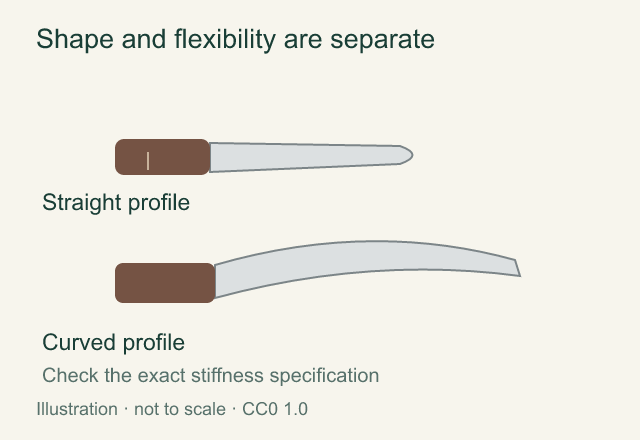
Curved and straight describe a boning knife’s profile. Flexible and stiff describe another property: how the particular blade is designed to yield in use. These choices are related to how a knife feels during a task, but one does not establish the other.
To choose between curved and straight boning knives, start with the route you need the edge to follow. Then check the exact knife’s flexibility, length, handle, and intended use. A preference for one profile should come from controlled kitchen work, not a rule that every curve is flexible or every straight blade is rigid.
What Curved and Straight Actually Describe
A curved profile changes the outline of the edge and the relationship between the handle and working point. A straighter profile presents a different path along the blade. Actual models vary: “curved” can describe a modest sweep or a more pronounced shape, while a “straight” knife may still have a shaped point or some edge curvature.
Look at the whole knife from the side. Ask how the working point will approach the ingredient and whether you can see the next part of the cut. A silhouette can help explain the shape, but it cannot tell you the blade’s stiffness, weight, or precise dimensions.

Flexibility Is a Separate Decision
The ZWILLING boning-knife description recognizes flexible and stiff blades within the boning category. Those terms concern how a specific blade responds during its intended work. They do not by themselves tell you whether the outline is curved or straight.
Greater flexibility is not automatically an advantage. The useful amount depends on the task, the ingredient, and the control you need. Likewise, choosing a stiffer blade is not a reason to lever a joint apart or chop hard material with a tool that is not intended for it.
Use the published specification and the supplied guidance. Do not press a blade into a bend to discover its rating. If a listing leaves the information unclear, ask about the particular model rather than filling the gap with assumptions from another knife that looks similar.
Compare the Profiles in Kitchen Tasks
| Selection question | Curved profile | Straighter profile |
|---|---|---|
| How does the working point approach the food? | The sweep may suit the contour and hand position you prefer | The more direct outline may suit another approach |
| What route will the cut follow? | Evaluate it on the visible contour you need to trace | Evaluate it on the straight or controlled route you need |
| What flexibility does it have? | Read the specific rating; do not infer it from the curve | Read the specific rating; do not infer it from the outline |
| Which is better overall? | Depends on the task and model | Depends on the task and model |
Contour Work and Close Trimming
When following a curved surface, the relationship between the handle and point can make one profile feel easier to position. That is a reason to compare actual models, not proof that a curve removes more meat cleanly in every situation. You still need to see the tissue boundary and reposition the ingredient as the angle changes.
Silverskin and fat trimming also depend on where the edge begins its cut and how much material you take at once. A shallow, visible route is more useful than a broad claim about blade shape. If you are losing meat with the trim, pause and improve the approach instead of assuming a different profile alone will fix it.
Straight Cuts and Familiar Technique
For another task, a straighter outline may fit the route and movement you already control. Familiarity matters because you need to know where the edge and point will travel. It is worth distinguishing a genuine control problem from the brief adjustment required to use an unfamiliar tool.
General knife-use discussions sometimes compare curved and straight blades for camping or everyday carry. Those are different tasks and are not a basis for selecting a kitchen boning knife. Keep the comparison tied to food preparation and the manufacturer’s intended use.
A Practical Selection Checklist
- Name the repeated job: trimming fat, following a seam, or separating meat near a joint.
- Inspect the actual side profile and working point rather than the category label alone.
- Find the stated flexibility or ask for model-specific clarification.
- Allow for blade length, handle length, and room to reposition the food.
- Assess whether your grip remains secure through the required movement.
- Check the permitted uses and maintenance instructions before choosing a demanding task.
You may find two knives with different profiles but similar intended roles, or two similar-looking knives with different stiffness specifications. Treat the full combination as the product. A single feature should not stand in for the rest of the information.
Check the Current SYOKAMI Model
The SYOKAMI 6.7-inch Boning Knife is currently listed as a straight-profile, flexible model. Its named size refers to the blade, while the handle adds to the space needed on the board and in storage. Check the listing and supplied guidance for the exact product.

The current listing describes this model as flexible but does not give a numerical stiffness grade or bending range. Do not infer those values from a photograph. Choose the intended task, work in controlled cuts, and avoid prying or trying to cut through hard bone. For the tool’s general role, see boning knife uses; for the separate fish-preparation question, read boning vs fillet knives.
The meat-cutting knife guide places these decisions alongside chef, carving, slicing, and cleaver tasks. That broader view helps you decide whether a boning knife is the next useful addition or whether another part of your setup needs attention first.
Frequently Asked Questions
Does a curved boning knife have to be flexible?
No. The profile and flexibility are separate properties. Read the exact product specification rather than inferring one from the other.
Is a straight boning knife always better for a straight cut?
Not automatically. The particular blade, ingredient, working angle, and your control all matter. Evaluate the complete model and its intended use.
Should a boning knife be flexible or stiff?
Choose according to the repeated task and the model’s instructions. Neither term is a universal quality ranking, and you should not force a blade to bend as a test.
Can I choose only from the product picture?
A picture can show the profile and some design details. It cannot establish a flexibility grade, steel specification, weight, or permitted hard-material use without supporting product information.