

Chinese Cleaver vs Meat Cleaver: Why Similar Shapes Do Different Jobs
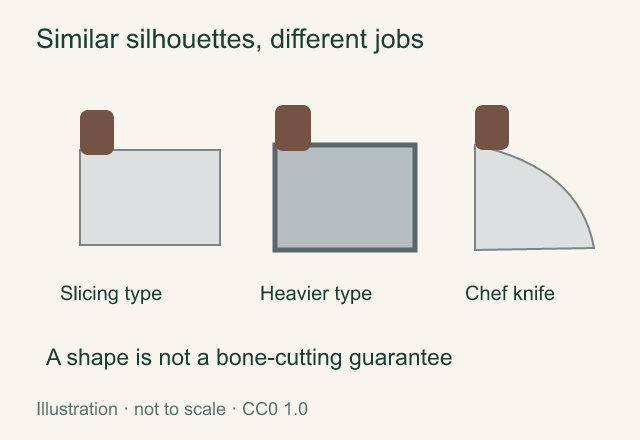
A Chinese cleaver and a meat cleaver can look related while being designed for different work. A relatively thin slicing or vegetable-cleaver design may suit everyday preparation; a heavier meat-cleaver design may serve particular heavier tasks. The actual model, not the national label or broad silhouette, establishes what you should do with it.
This comparison explains the design questions to ask before choosing or using a cleaver. It does not assume that every Chinese cleaver is thin, every Western cleaver is heavy, or every product called a meat cleaver can chop any bone.
Why the Names Can Be Confusing
Knife descriptions draw on shape, customary use, and regional terminology, and those descriptions can overlap. “Chinese cleaver,” “vegetable cleaver,” “slicing cleaver,” “meat cleaver,” and “butcher cleaver” do not form one perfectly standardized catalog system.
A Chinese slicing cleaver is often discussed as a broad general-preparation knife rather than a bone-chopping tool. Other cleavers emphasize different jobs. Read the Culinary Arts Academy Switzerland knife-type overview for the broader categories, then use the maker’s information for a particular blade.
When a listing gives you a category name but little practical information, ask what ingredient and movement it is intended for. A clear use description is more helpful than assuming a capability from a word.

Compare the Design and Intended Work
| Feature to inspect | Slicing or vegetable-cleaver type | Heavier meat-cleaver type |
|---|---|---|
| Typical emphasis | Controlled cutting of suitable everyday ingredients | The heavier tasks specifically permitted for the model |
| Blade and edge | Often relatively thin for slicing; verify the model | May use a more substantial design; verify actual specifications |
| Weight and balance | Must remain manageable for repeated preparation | Assess the actual tool and the work it is intended to do |
| Cutting motion | A controlled motion matched to its edge and food | Only the motion and material described by the maker |
| Main mistake to avoid | Treating a thin slicing blade as a hard-bone tool | Assuming a heavier appearance permits every hard ingredient |
These columns describe common tendencies. They are not numerical specifications for every knife in either category. If thickness, weight, or edge geometry matters to your choice, look for actual model information. A picture can show a profile but cannot certify all of those properties.
The same applies to durability and edge retention. Those cannot be ranked from country labels or a broad silhouette. Use substantiated product information and, where relevant, clearly described testing rather than treating a category as a performance score.
Which Tasks Suit Which Design?
Thin Slicing and Everyday Preparation
For a suitable slicing-cleaver design, the broad face and edge profile can support controlled vegetable preparation and other intended board tasks. The useful movement depends on the blade’s actual curve and how the ingredient is positioned. Keep the food stable and the edge’s route visible.
A broad face can also make it harder to see the supporting hand. Recheck your fingers as the ingredient gets smaller and give the blade enough room to travel. The blade’s height is a design feature, not a substitute for appropriate hand position.
For moving chopped ingredients, protect the edge and keep your hands away from it. Do not scrape the sharp edge across the board. A separate bench scraper may be more convenient when transferring a large pile of prepared food.
Heavier Tasks Only When the Model Permits
Some cleavers are intended for particular heavier meat-preparation tasks. That does not establish one universal permission for every bone, joint, or frozen ingredient. Check the manufacturer’s directions about the exact type and size of material and the permitted technique.
Do not demonstrate a capability to yourself by striking something hard with an unfamiliar knife. If you cannot confirm suitability, choose an appropriately specified alternative or arrange for the ingredient to be prepared differently. A wide blade and a substantial handle do not fill a missing instruction.
In particular, distinguish separating meat around a bone from cutting through the bone. The first can call for a suitable narrow boning tool and close control. The second is a different task. A difficult joint should not automatically be solved by replacing careful positioning with a larger impact.
When Another Knife Is a Better Fit
A cleaver need not cover every stage of a meal. A chef knife may feel more manageable for familiar everyday work. A boning knife may improve access to a small contour. A long carving or slicing blade may provide more useful travel through a cooked roast.
Our cleaver vs chef knife comparison focuses on general preparation. The meat-cutting knife guide explains the more specialized stages. Together, they make it easier to choose by task instead of trying to stretch one broad blade into every role.
Read a Cleaver Listing with Practical Questions
- What ingredients does the maker explicitly describe? Look for actual tasks, not only dramatic product names.
- What are the blade length, overall dimensions, and available weight specifications? Allow for the full tool in use and storage.
- How is the edge meant to move? Compare that with the way you prepare food.
- Are separate edge zones, openings, or other features explained? Do not invent a grip or task for an unfamiliar feature.
- What are the stated restrictions for bones, frozen food, prying, or twisting?
- What cleaning, drying, and protective storage routine does the model require?
If an important answer is missing, ask about the specific knife. A generic description of another cleaver is not a substitute for the information needed to choose this one. It is especially important to avoid transferring a heavy-duty claim from a different model with a similar shape.
How This Applies to the Artsy Cleaver
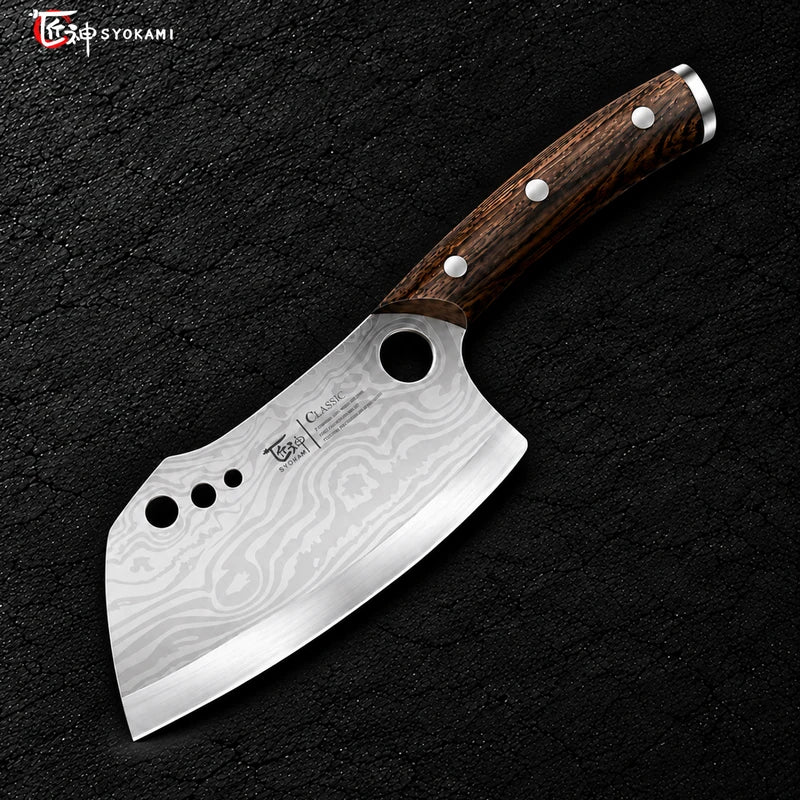
The SYOKAMI Artsy 7.7-inch Cleaver has two cutting zones, a textured area near the handle, one large opening near the grip, and three smaller graduated herb-stripper holes. Its current product information describes suitable vegetables, herbs, and boneless ingredients.
Use the front section for the suitable slicing and dicing work described in the instructions. Consult the model-specific guidance before heavier use of the rear section. The listing cautions against twisting, prying, and frozen food. We do not infer additional hard-bone capability from the unusual outline or the existence of two edge zones.
Keep your main hold on the handle. Do not place fingers through blade openings during cutting. The smaller holes have a stated herb-tool role, while the larger opening is a separate design detail. The cleaver uses guide explains those differences and the basic preparation routine.
Care and Storage Follow the Actual Knife
Hand wash and dry current SYOKAMI knives promptly according to their supplied guidance. Clean around openings and joins without bringing fingers into the edge’s path. Store the blade protected and the handle reachable without searching around sharp metal.
Do not assume a stainless-steel description or a decorative pattern makes soaking, careless storage, or unattended sharp blades acceptable. A tool’s appearance does not replace its care instructions. Before choosing a large cleaver, make sure its full profile will fit the protective storage you plan to use.
When food preparation includes raw meat, keep the work separate from ready-to-eat ingredients and clean contact surfaces appropriately. A change in cleaver type does not change that basic kitchen routine.
Check the storage opening as well as the space where you will use the knife. A broad blade may need a different protective arrangement from a narrower chef knife. Make sure the holder actually fits the profile and that you can remove one knife without reaching around another exposed edge. Storage fit belongs in the purchase decision, not only in the cleanup routine.
A Simple Way to Decide
If your repeated need is controlled preparation of vegetables and suitable boneless ingredients, compare models intended for that role. If you have a specific heavier task, identify it precisely and choose only a tool whose maker permits it. If you mainly want a familiar everyday knife, compare the actual cleaver with a suitable chef knife before adding another category.
This approach lets two similar-looking knives have different purposes without declaring one universally better. The useful choice is the model whose design, instructions, and handling fit the work you actually do.
Frequently Asked Questions
Can a Chinese cleaver cut bones?
The label alone cannot establish that. Many slicing designs are not intended for hard-bone work. Check the exact model and the material involved before assigning the task.
Is a meat cleaver useful for vegetables?
Some models may be suitable for particular vegetable tasks, but a heavier tool may be unnecessary or less manageable for routine preparation. Read the intended use and compare the actual design.
Does butcher cleaver mean it can cut any bone?
No. Product names are not universal material or technique permissions. The maker’s limits for the particular model remain essential.
How do I identify the cleaver I already own?
Look for the model name and supplied instructions, then check the actual dimensions, profile, and permitted tasks. If those are unclear, ask the maker rather than guessing from the silhouette.