

Carving Knife vs Slicing Knife: Differences That Matter at the Board
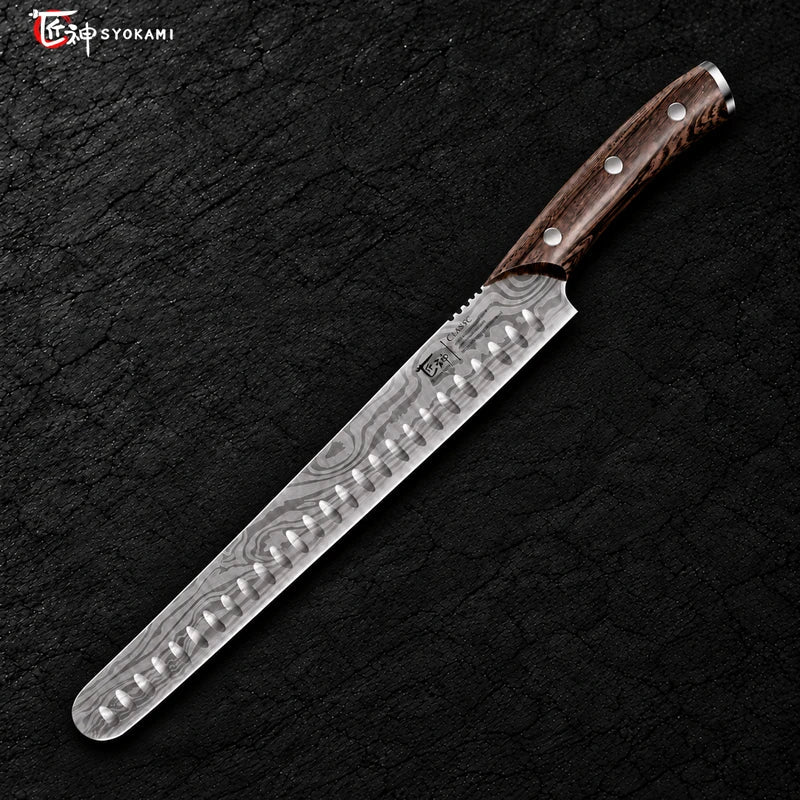
A carving knife and a slicing knife both help portion food, especially cooked meat. In typical designs, a carving knife gives you a narrower working point for positioning around a roast or cooked poultry, while a long slicing knife emphasizes repeated strokes through a large boneless portion. The names overlap, and the actual blade is more informative than the label.
Choose according to the part of serving you are doing. Working beside a joint and drawing a slice through a brisket require different access. Start with the food and the space on the board, then compare the tip, length, and profile.
Carving and Slicing Knives Compared
| Feature | Typical carving design | Typical slicing design |
|---|---|---|
| Main emphasis | Positioning and portioning cooked meat | Repeated slices through a larger cooked portion |
| Tip | Often pointed, but designs vary | Often rounded, but designs vary |
| Blade | Usually narrower than a general-purpose chef knife | Often long and relatively narrow |
| Working space | Must allow controlled access around the portion | Must allow the long blade and stroke to move freely |
| Useful comparison | How precisely can you position this particular knife? | How much usable slicing travel does this knife provide? |

These are common design tendencies, not rules that sort every knife into two separate boxes. The Culinary Arts Academy Switzerland knife-type guide places carving and other specialist blades within their kitchen tasks. A listing may use “carving” for a long blade that also serves a slicing role, so read the specification and look at the whole profile.
Which Task Are You Trying to Make Easier?
Carving a Roast or Cooked Poultry
When carving, the immediate question is often where the blade needs to enter. You may be following the side of a cooked breast or separating meat near a joint. A manageable working point can help you position the cut, but it cannot replace recognizing the joint or seam. If the blade meets hard resistance, stop and find a clearer path.
Once a portion has been removed to the board, the job changes. You have more room to orient the meat and make serving slices. That is why the same meal can involve both careful carving movements and long slicing strokes. Our turkey carving guide treats them as separate stages instead of forcing a single motion through the whole bird.
Slicing Brisket and Large Boneless Portions
A long blade can travel across a large piece of cooked meat without requiring frequent reversals. The useful length is the part you can move in a controlled path. If the edge extends into clutter or beyond a small board, its extra length may be inconvenient.
Blade length also does not fix an incorrect cutting direction. With brisket, find the grain in the section you are about to slice, then cut across those fibers. The flat and point can point in different directions. See how to slice brisket against the grain for an illustrated process and ways to adjust when slices tear or crumble.
What the Blade Details Tell You
Look first at the point, the usable edge, and the handle position. A rounded nose avoids a projecting point at the front, but it is still a sharp cutting tool. A pointed tip can enter a specific area, but it should not be used to pry. Neither design is automatically safer; suitability depends on the task and controlled use.
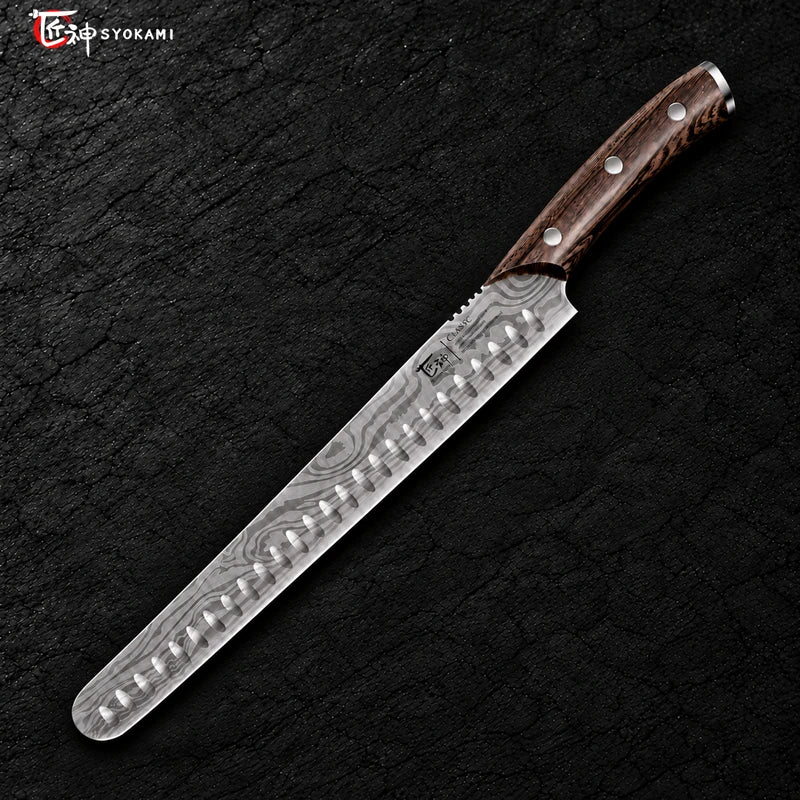
Some blades have hollow-edge dimples or other surface features. Treat those as design details rather than a guarantee that food cannot cling. The food’s texture and moisture, the edge condition, and the cutting motion still matter. Decorative blade patterns likewise do not establish a steel grade or a particular construction method.
The SYOKAMI 12-inch Carving Knife is a concrete example of overlapping labels. Its current profile is long and narrow with a rounded nose, and the product page presents it for suitable slicing work. Use its actual features and instructions to judge the task rather than assuming “carving” must mean a pointed blade.
Choose for the Food and the Space
Before buying, imagine the full movement at your own board. Consider the portion’s width, where your supporting hand will sit, and the clear space beyond the cut. Allow for the handle as well as the blade. The nominal blade length is not the knife’s total length.
- For repeated brisket or boneless-roast slices, prioritize a suitable length and a controlled drawing stroke.
- For work close to a cooked joint, prioritize access and a manageable working point.
- For mixed meals, consider which task you repeat most often and whether a knife you already own is suitable for the occasional other job.
- For any hard resistance, improve the position or change tools according to the task; do not twist a narrow blade to make it work.
Can You Use a Chef Knife Instead?
A suitable chef knife can portion smaller cooked meats and perform some carving tasks. You may find it entirely adequate when the food is manageable on the board. A specialist becomes more useful when the chef knife feels too broad for access or too short for the repeated slicing you regularly do.
There is no requirement to add a second knife simply because two category names exist. Compare the actual problem you want to solve. The meat-cutting knife guide connects trimming, boning, carving, and slicing needs so you can judge the whole setup rather than making a decision from a single feature.
Frequently Asked Questions
Can I use a carving knife to slice brisket?
Yes, when its actual profile, length, condition, and intended use suit the task. Many products have overlapping carving and slicing roles. A product name alone cannot tell you whether it will provide enough controlled travel for your brisket and board.
Does a slicing knife always have a rounded tip?
No. Rounded noses are common on some long slicers, but knife labels and designs vary. Check the actual model instead of treating the tip as a universal definition.
Is a bread knife the same as a slicing knife?
A bread knife normally uses serrations suited to working through crust with a sawing stroke. Some can serve as an occasional alternative for particular foods, but the edge, blade, and result differ. Choose the tool appropriate to your food rather than assuming that all long knives are equivalent.